in revenue earned by Mews within the first six months
Mews · Embedded finance
Mews Capital
Making embedded financing easier to understand, access and manage within the hotel’s daily operations.
ImpactMews Capital
response time, depending on YouLend’s assessment and acceptance of the application
of customers renewed their financing in the first year
01Context
Opportunity does not wait for funding.
Hospitality runs on seasonal cash flow. Property owners need to meet financial obligations while finding room to reinvest in growth.
Traditional financing often demanded extensive paperwork, prolonged negotiations and years of operational history. Funds could take weeks or months to arrive, leaving operators unable to act when an opportunity appeared.

02Research
Understanding how operators decide.
I conducted approximately 20 interviews across Europe to understand how operators approached financing: their decision logic, past experiences and barriers. I complemented the interviews with a survey to quantify behaviours, patterns and attitudes toward credit.
Access exists. It just does not work.
33% of SMBs had used external financing; 77% of those used traditional banks. The dominant option was slow, rigid and misaligned with how they operated.
Growth is the trigger. Timing is the blocker.
75% sought funding to grow or improve their business. Waiting for access could mean missing the opportunity that prompted them to seek funding.
Price matters. Speed matters too.
Pricing was the leading decision factor, followed closely by speed. Operators needed funding they could afford and access in time to use.
03Reframing the problem
From offering financing to supporting confident decisions.
Across markets, operators struggled with opaque terms, the effect of repayments on daily operations and the possibility of hidden costs. Speed alone would not resolve those concerns.
How do we help hotel operators make confident financial decisions in the context of their daily operations?
This question shaped the offer, the repayment experience and when—and to whom—we surfaced the product.
Market coverage shaped the partner decision
Mews could not provide the financing itself, so the experience depended on a partner’s capabilities and supported markets. We considered Stripe Capital, but its country coverage at the time did not cover the markets we needed. We selected YouLend and white-labelled its merchant cash advance solution.
Coverage was only one part of the decision. We also needed fast access, a straightforward application and repayments that respected seasonality. The partner choice had to support the hotel’s needs as well as the markets where Mews operated.
Repayment that follows the business
Repayment was tied to daily card sales rather than a fixed monthly schedule. Higher sales meant higher repayments; lower sales meant lower repayments. This connected the repayment model to the seasonal rhythm of the hotel.
Connecting the partner flow with the Mews experience
The application flow and the product page inside the PMS needed patterns the existing design system did not support. My design work included new components that could serve both parts of the experience.
04Beta
A simple eligibility rule created false expectations.
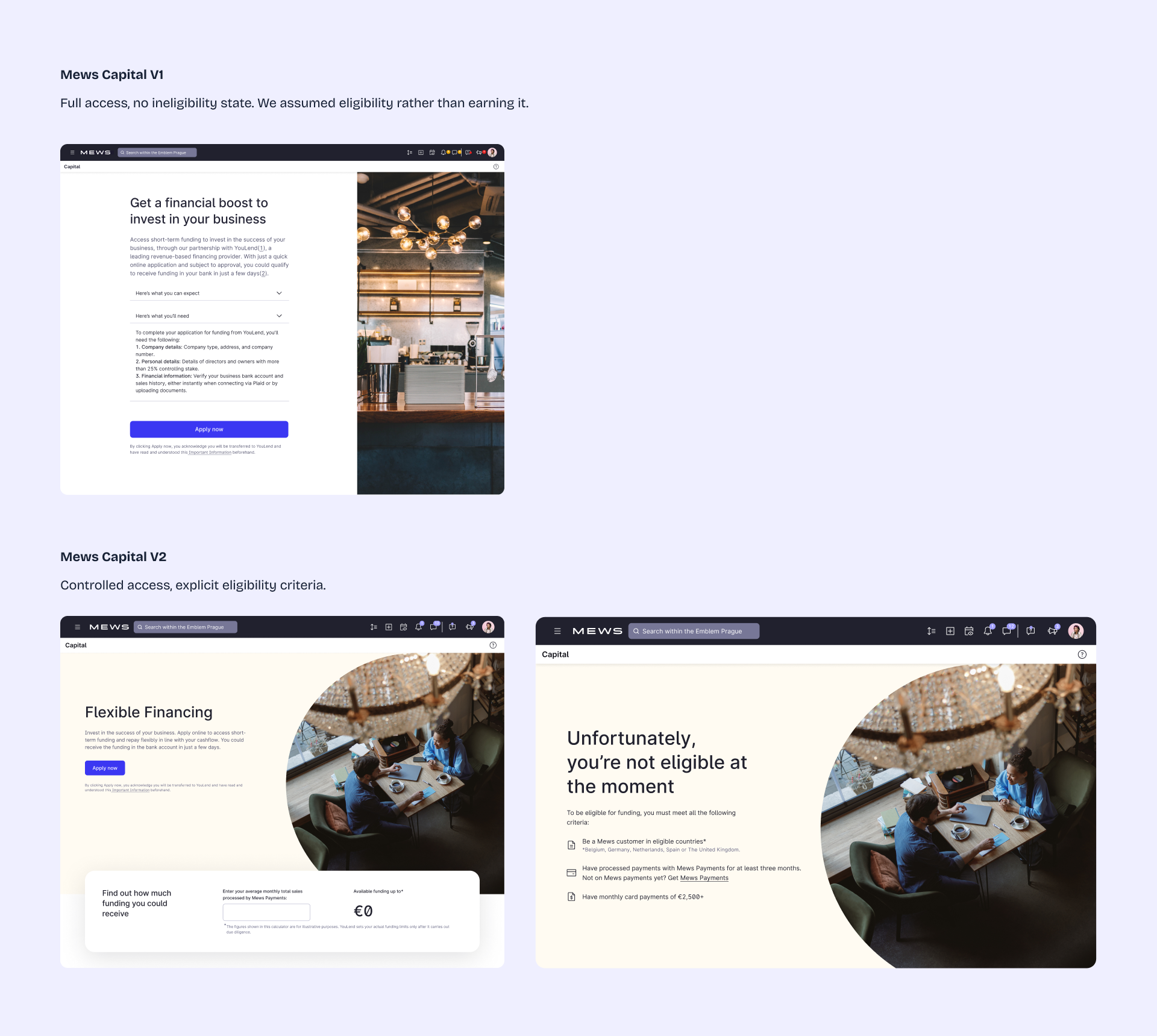
The beta had a single entry point: a landing page that forwarded customers to YouLend. I designed it around a simple eligibility message—three months of payments meant access.
What went wrong
We shipped without accounting for the edge cases. Ineligible users and low-revenue businesses reached the application flow, creating an expectation of access that the product could not meet.
This exposed a gap between communicating eligibility and ensuring the experience respected it. I revised the entry point to make access criteria explicit and include an ineligible state, rather than inviting every customer into an application they might not qualify for.
05Launch
From a referral to financing inside the PMS.
After testing with users, we moved to a more detailed, embedded experience. Operators could understand the product, simulate financing options and apply from the system they already used to run their business.
Understand and simulate
A product experience inside Mews helped operators explore what they could access before applying.
Apply and choose an offer
The flow reused customer information already held by Mews, reducing repeated data entry and the need to repeat the KYC/KYB steps described in the original journey.
Track and renew
Customers could follow repayments in the dashboard and apply for renewal, keeping ongoing financing visible alongside their operations.
06Learnings
What I learnt
The beta showed me that an entry point creates expectations before an application starts. A simple three-month rule was not enough: eligibility needed to account for edge cases and revenue, and explain access before inviting someone into the flow.
Fast financing only helps when operators understand what they are accepting. The research pushed me to connect the offer, repayment model and ongoing visibility so customers could judge the impact on their business.
Moving from a referral page to embedded financing meant designing across partner boundaries, existing customer data and the Mews design system. The work extended from discovering an offer to tracking repayment and applying again.