hours saved per finance team on manual reconciliation each month
Mews · Financial servicesLaunched · 2026
Financial
Dashboard
Turning fragmented financial operations into one clear, trustworthy system for hospitality finance teams.
Dashboard impactFirst quarter after launch
Results from the Financial Dashboard in its first quarter after launch: monthly time saved per finance team on reconciliation, European-market dashboard adoption and Fintech revenue uplift attributable to the dashboard.
adoption across the European market
revenue uplift linked to the dashboard in the first quarter
01Context
Where's my money?
Mews ↗ helps hospitality businesses manage operations and payments. But finance teams still lacked reliable infrastructure to understand their position, trace payments and see what was coming next.
Cash visibility, reconciliation and forecasting lived across disconnected systems. Teams manually created bills, duplicated charges, set reminders, tracked due dates and chased missed payments every month. The process was time-consuming, error-prone and impossible to scale.
02Research
Understanding the system before designing the screen.
I shaped a research strategy around operational pain points, decision-making and the conditions required for finance teams to trust embedded financial services.
20+hotel-group interviews
152+survey responses
3ideation workshops
7internal disciplines
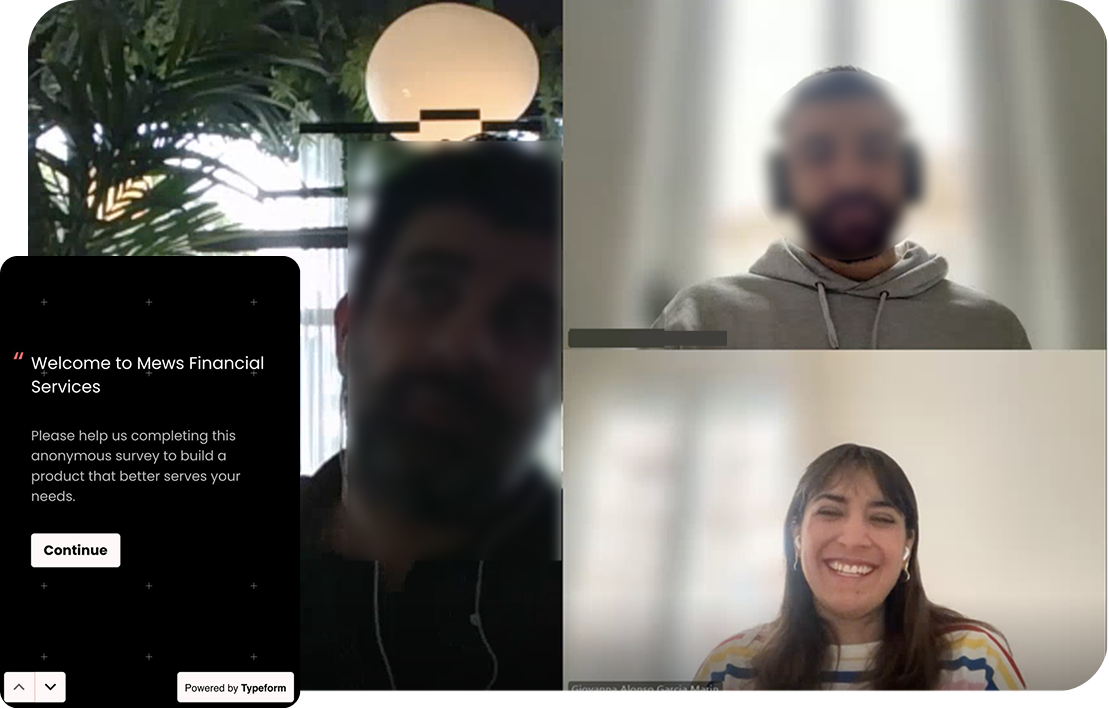
We included hotel groups across countries and operating models, then connected their perspective with Revenue, Finance, Guest Experience, Pricing, Legal & Compliance and Customer Support. The work exposed gaps in the end-to-end ecosystem and helped define both product strategy and MVP scope.
Visibility earns trust. Trust unlocks automation.
Nobody asked for a balance overview
CFOs, finance controllers and general managers described the problem differently, but they all needed the same thing: to understand when cash would arrive, whether unpaid invoices would convert and where money was while it moved. The need was not a number—it was money positioned across time and certainty.
Trust is the foundation, not a feature
Finance teams would not let a PMS manage their money until it proved that the underlying data was reliable. That changed the roadmap: begin with accurate visibility and reconciliation, then earn permission to automate money movement.
Growth was adding complexity, not control
People were the glue between disconnected systems—chasing invoices, reconciling data and moving deposits manually. The opportunity was not to make that work faster, but to break the link between business growth and operational headcount.
BenchmarkFinding the opening
Competitors solved fragments. Mews could connect the whole journey.
I studied accounting and AR suites—Stripe, Xero, QuickBooks and BILL—alongside payment tools such as Revolut, Wise and PayPal.
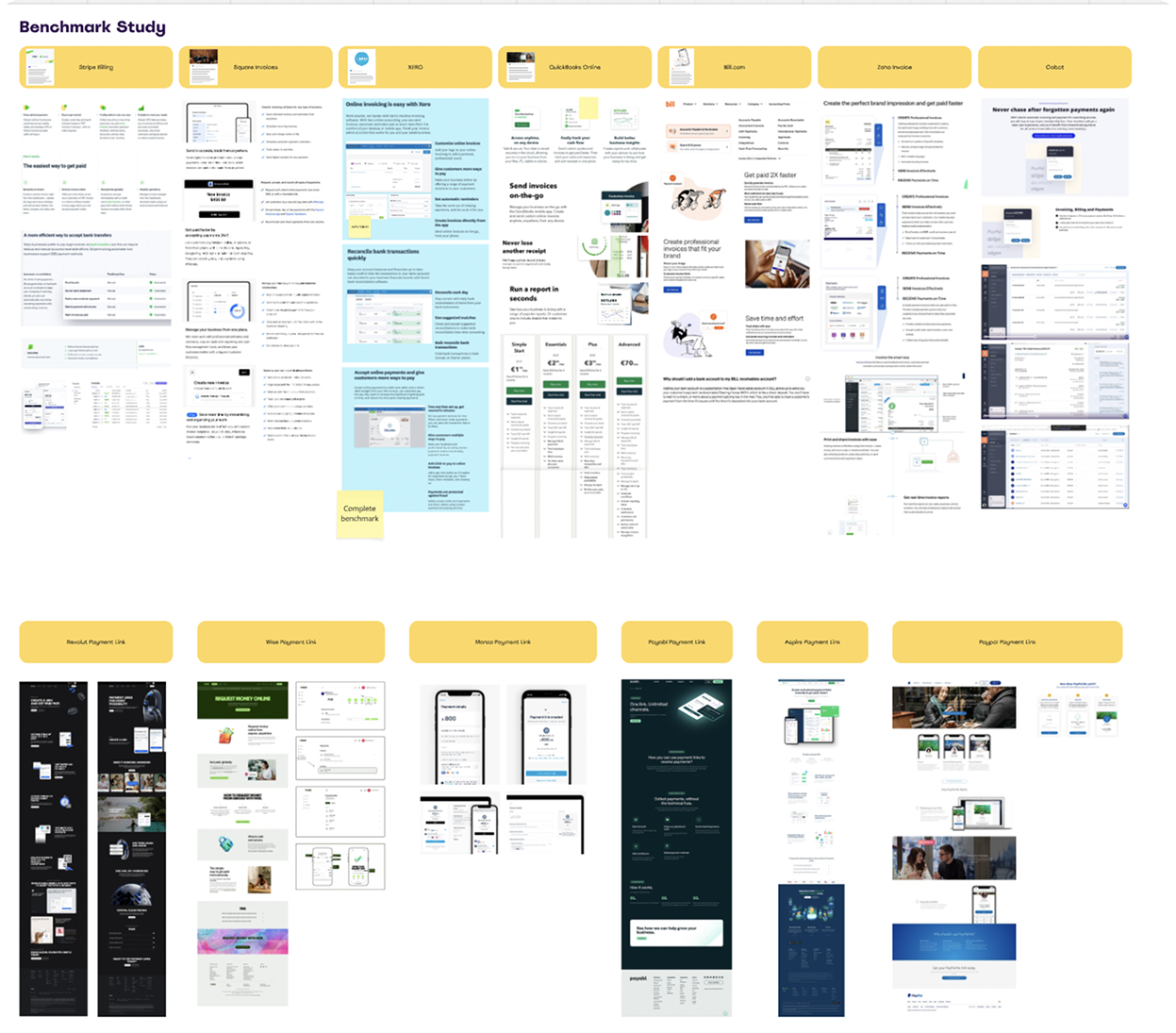
Everyone else starts from zero
Accounting suites serve any business, so users first have to recreate the context. Mews already knows what is expected from the PMS—and when.
Reconciliation can be true by default
For accounting tools, reconciliation is a task. Because Mews creates both the operational event and the money movement, it can automate the connection.
Payment links stop when money lands
Payment tools help businesses get paid, but they do not explain cash position, forecast what comes next or show what remains outstanding.
I changed the scope from a simple BI dashboard displaying financial metrics to an all-in-one operational dashboard for financial control and visibility. Research showed that finance teams needed more than reporting: they needed to understand where money was and act on that information.
The original brief focused on presenting existing BI metrics. I reframed it around the current and future state of money, end-to-end payment traceability and connected financial workflows. This made operational control—not just metric visibility—the focus of the product.
Lead with trustworthy visibility, automate to increase operational efficiency.
Expanded the brief from BI reporting to financial operations, using customer research to connect visibility, reconciliation and money movement in one dashboard.
Aligned product, engineering, risk, legal and compliance around what could ship now and what needed new infrastructure.
Covered product-management responsibilities for eight months, balancing discovery, prioritization and delivery with design quality.
03Design
From reporting dashboard to financial operating system.
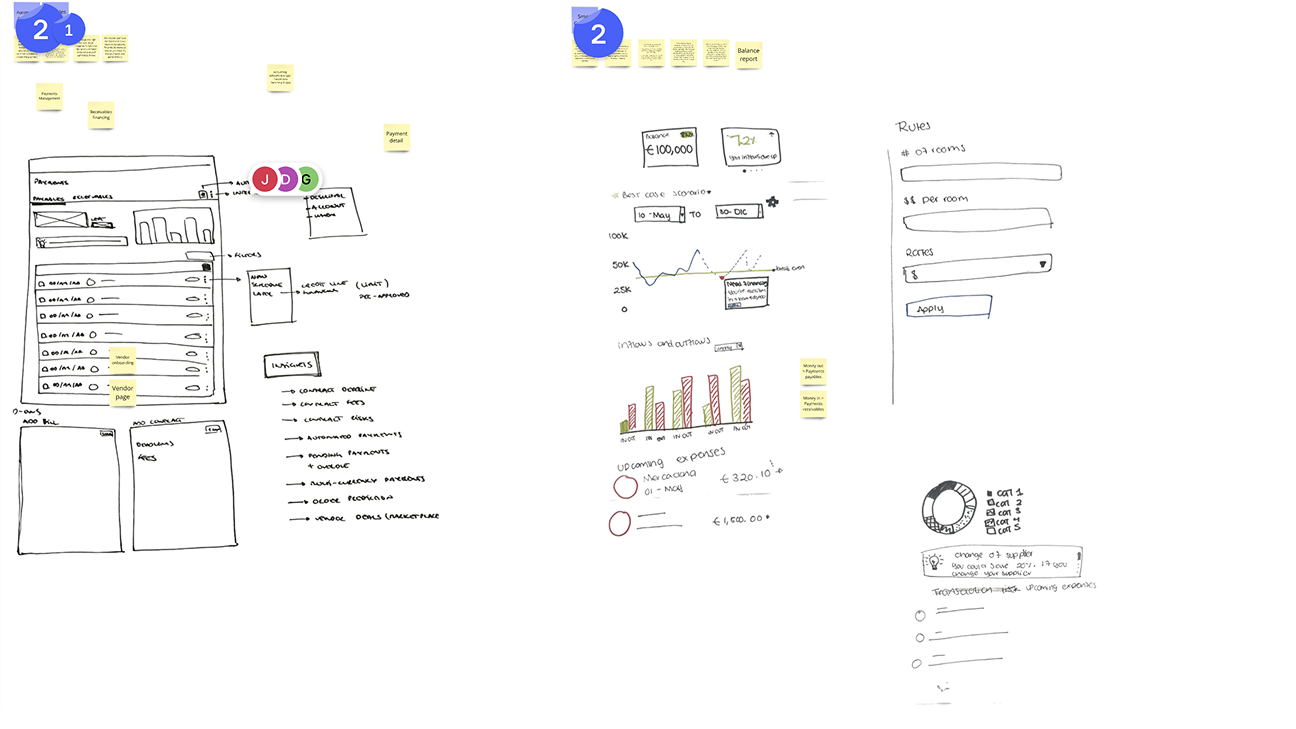
I facilitated customer co-design workshops, then led a team design sprint to translate insights into product concepts. As designer and interim PM, I iterated on the information model, metrics and visualizations while balancing user value with technical constraints.
EvolutionV1 → V3
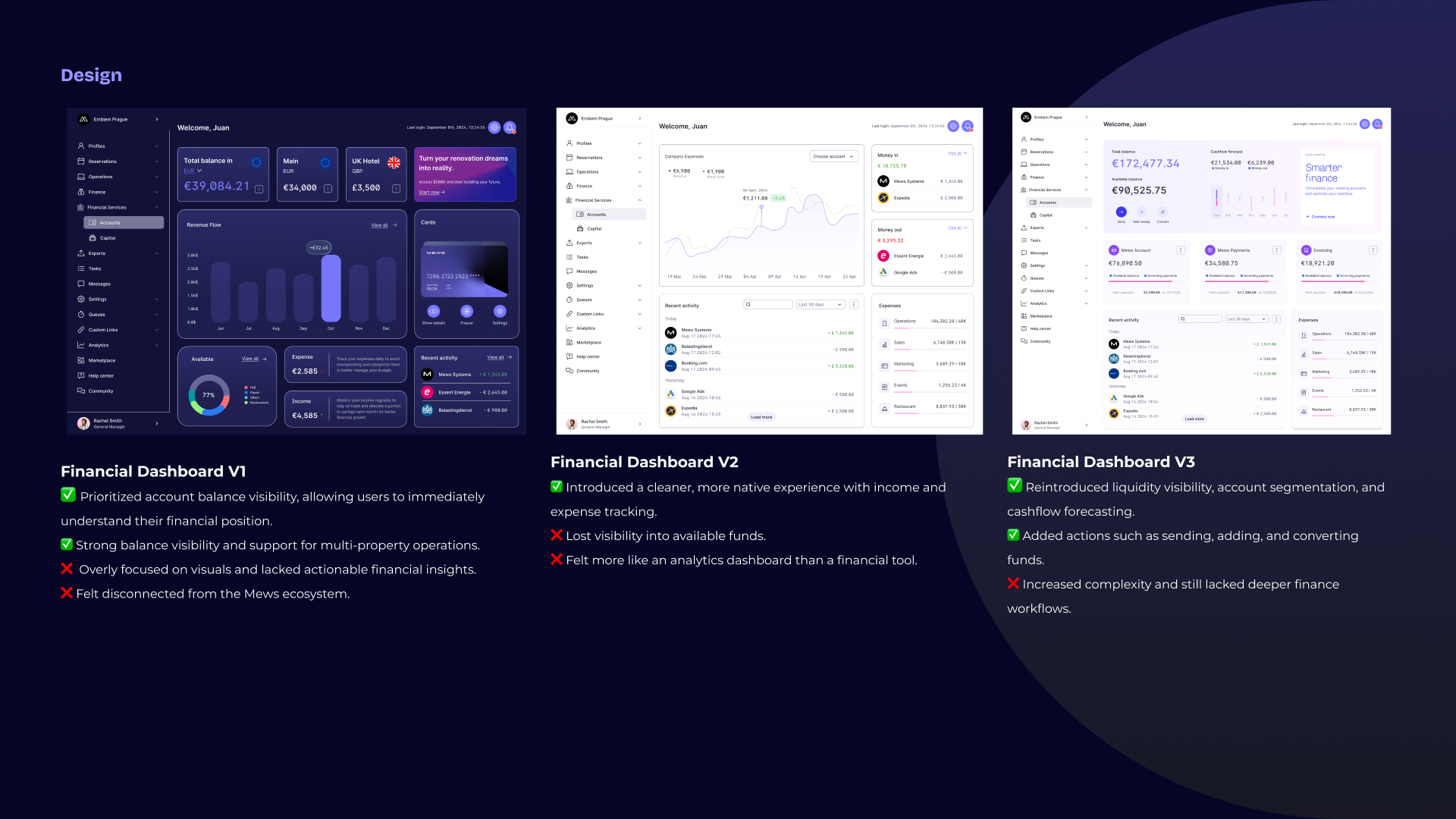
Final system
Visibility and action, designed as one ecosystem.
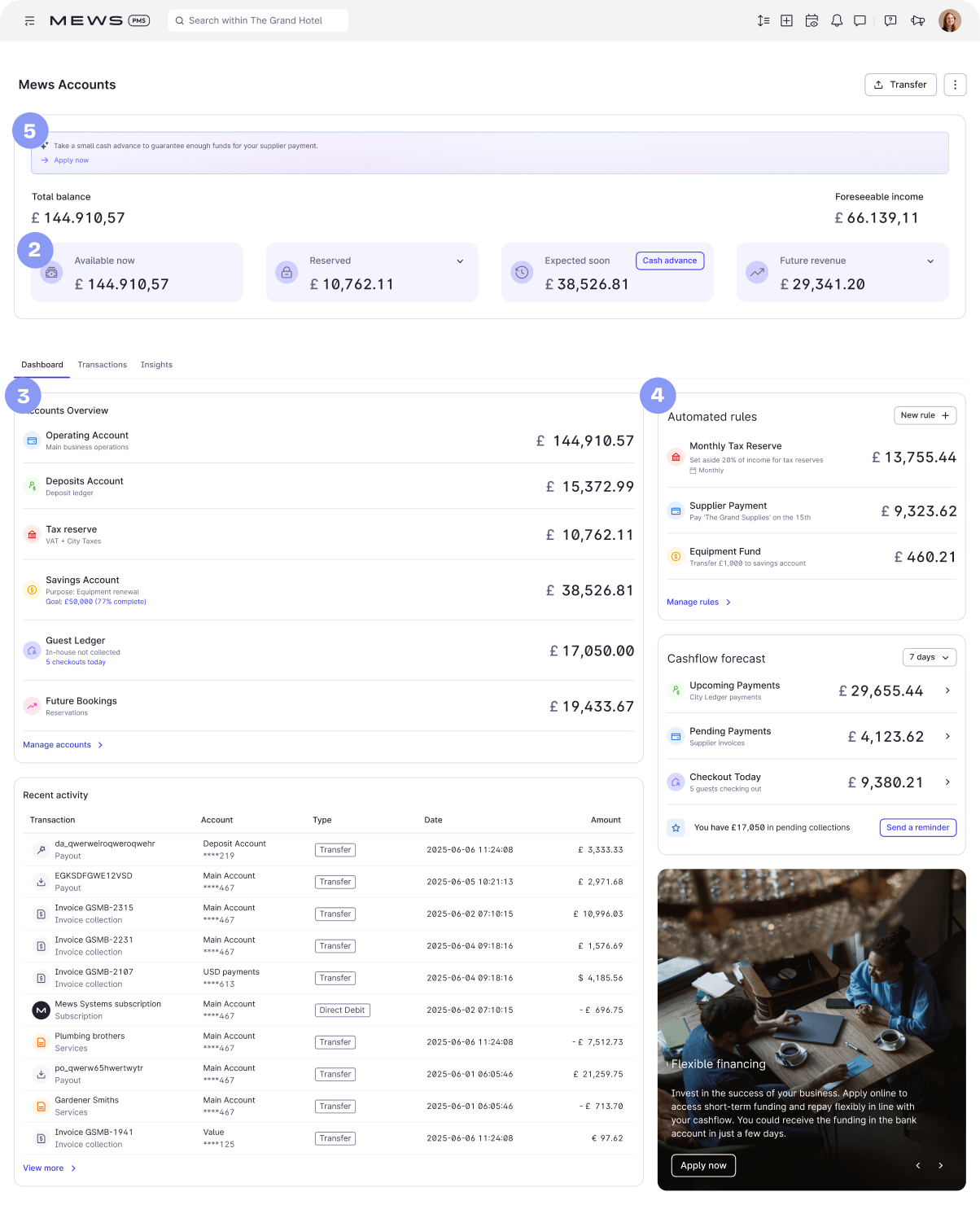
The final direction connected the Financial Dashboard with Accounts Receivable so teams could move from understanding a problem to resolving it without leaving Mews.
- 01
Embedded financial management natively within Mews to build trust and adoption.
- 02
Reframed financial health through Available now, Reserved, Expected soon and Future revenue.
- 03
Introduced finance-specific accounts, reserves and savings structures.
- 04
Automated fund allocation, reconciliation and supplier payments.
- 05
Connected cashflow insights to relevant financial products and financing opportunities.
- 06
Shifted the experience from passive reporting to proactive financial management.
Design detailMaking money understandable
What can I spend, and what is still to come?
The balance model separates money available to use from funds set aside, money in transit and revenue that has not yet been collected.
- Available now
- Money the hotel can use immediately, separate from funds shown under Reserved.
- Reserved
- Funds tracked separately from spendable money: the deposit account balance, chargeback reserves held to cover disputes, refunds or fraud, and tax reserves put aside for tax payments.
- Expected soon
- Money already in transit, such as payouts awaiting settlement.
- Future revenue
- Unpaid guest balances, outstanding accounts-receivable invoices and future bookings. Future bookings may still change or be cancelled.
The stay and the payment are different events.
Unpaid reservations and invoices are already registered in Mews. Future bookings generate a bill or invoice when the reservation is confirmed or its cancellation period ends. The amount remains in future bookings until the stay has happened. It then leaves that category; if still unpaid, it remains represented as an outstanding guest balance or invoice.
This distinction helps finance teams understand when revenue is expected without confusing it with money that has actually arrived.
04Learnings
What I learnt
The dashboard and Accounts Receivable became more valuable together: one created visibility, the other made the insight actionable.
Reducing manual reconciliation mattered, but making the underlying data dependable was what allowed teams to act with confidence.
Working across product design and product management strengthened how I shape strategy, negotiate trade-offs and make design part of product decisions.